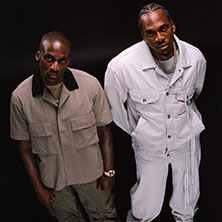
In the more than 15 years since the last Clipse album hit the shelves of record stores, the music world has been upended several times over. Mixtapes went from Canal Street to DatPiff to Spotify; the old versions of the major labels were destroyed and new ones built in their place; hip-hop itself underwent mutation after mutation, styles falling in and out of vogue, one-time superstars becoming legacy acts or drifting off into the ether. Through it all, though, enthusiasm for the duo from Virginia never waned. Let God Sort ‘Em Out - Clipse’s new independent release in partnership with Roc Nation - is one of the most highly anticipated releases in recent memory, a fact that simply underlines the singular talent and lasting influence of Pusha-T and Malice. After all, there’s no substitute for the real thing: groundbreaking artists with unimpeachable resumes. “You see great rappers all the time,” Pusha says, before contrasting he and his older brother with those who are not truly of the culture. “But there's something a little off about it.”
Let God Sort ‘Em Out has no such problems. Over 13 taut, kinetic beats from longtime collaborator Pharrell, Pusha and Malice exorcise demons and catalog areas of personal growth—without ever sacrificing the menace and minimalism that made them first cult heroes, and then legends of the genre. It is a master class in maturing without abandoning one’s core identity, but rather deepening it, making it more three-dimensional. According to Malice, Clipse’s staying power is proof not only of adoration and respect, but a higher purpose. “The fact that it has remained viable for so long has allowed me to say, ‘Hey, this must be meant to be.’” Whatever its provenance, the new LP is an instantly unforgettable contribution to the duo’s catalog, and to hip-hop writ large.
The history of Clipse has been well-documented, yet still retains a sort of mythic quality. The brothers emerged from Virginia Beach, where they had met the Neptunes, who would help them craft some of the most forward-thinking rap music of this century. Their career has been marked by the kind of industry red tape that can mummify entire careers and keep brilliant music out of the public eye, first with their would-be debut album, Exclusive Audio Footage, and later with their sophomore effort, Hell Hath No Fury. But the brothers persisted. When the latter album was finally released in 2006, it was immediately hailed as a masterpiece—today, it still sounds as if it’s from the far future. On those records, as on their monumental 2002 debut Lord Willin’, 2009’s Til the Casket Drops, or their unforgettable mixtape run from the mid-2000s, Pusha and Malice articulated a a complex worldview, one informed by the dark realities of the drug trade (and haunted by its physical and psychological consequences) but unapologetic about their determination to survive a cruel world.
Through the 2010s and into the ‘20s, the brothers took divergent professional paths. While Pusha embarked on an illustrious solo career, starring in his guest appearances on Kanye West’s My Beautiful Dark Twisted Fantasy and dropping seminal works of his own (most recently 2018’s Daytona and 2022’s It’s Almost Dry), Malice—who for a time changed his name to No Malice—explored more deeply than ever before the spirituality that had long informed his work. “In my verses, I always implemented something scriptural,” he says. “I didn’t necessarily live by it, but it sounded so cold that nothing could supersede that. Now I understand how important it is to have an undying, everlasting hope. Before, I was being cool with it. Now I understand what it means.”
This unmistakably alchemy—vicious renderings of crime and the sense of a moral code that lurks just underneath—is what makes Let God Sort ‘Em Out so arresting. This is true from the album’s opening moments. The John Legend-assisted “Birds Don’t Sing” explores the passing of the duo’s mother and father, each brother rapping about one parent. “It was painful to do,” Pusha says. “It was hard to even get through it, to do it in the studio.” By placing that track first, he and Malice signal that, while their technical skills are sharper than ever, this is an album that could only be the product of time—of growth, tragedy, and recovery.
It’s also filled with the type of razor-toothed exercises that made Clipse icons in the first place. Take the taunting “Inglorious Bastards” or “Marie Kondo,” which scoffs at “60-day stars and 20-year thousandaires.” The beats, which Pusha describes as “polarizing,” sound like a further refinement of Pharrell’s unforgettable work on It's Almost Dry: urgent, technicolor, and with plenty of space for the vocal to become the track’s most important instrument. The spare, exhilarating “MTBTTF” warps and bends around their voices alone.
After so long away, it’s only natural that Clipse would have too much to say to overstuff a tracklist with guests. They’ve kept the supporting cast spare: longtime partner Ab-Liva is joined by a pair of legends, Nas and Kendrick Lamar. Despite that star power involved, the brothers found slots for these MCs where they intuitively fit—Kendrick on the swaggering “Chains & Whips,” Nas on the back end of the breathless “Chandeliers.” As fans have come to expect from the group, each piece is merely a component part of a considered whole.
In discussing the album, the brothers return again and again to the idea of authenticity. That’s not just a literal list of deeds done, but a sense of purpose, of cultural investment, and of honesty. “People always talk about the culture,” Pusha says, “the culture of music and the culture of rap. But the truth of the matter is that this culture that they speak of is what you have to be entrenched in. You have to be entrenched in it for people to look at you a certain way.” The need to be authentic is paramount, but it’s also natural to these two. Perhaps Malice puts it most clearly: “Nothing else works for us.”