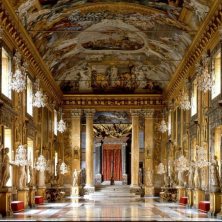
A true jewel of Roman the Baroque, the Galleria Colonna was commissioned in the mid 1600s by Cardinal Girolamo I Colonna and his nephew Lorenzo Onofrio. It was inaugurated by Philip II, Lorenzo Onofrio’s son, in 1700. The original project was by architect Antonio del Grande, it was then integrated by Gian Lorenzo Bernini, Johan Paul Schor and Carlo Fontana in the last decade of the seventeenth century.
From the very beginning, the Gallery was conceived as a huge state room, which was to celebrate the victory at the Battle of Lepanto in 1571. The commander of the papal fleet, Marcantonio II Colonna, is depicted numerous times throughout the vault of the Great Hall of the Gallery, in the Hall of the Battle Column and in the Hall of the Landscapes.
The Gallery retains all the charm of a Roman patrician residence from the Baroque era; in addition to the gallery’s splendid vaulted ceiling, frescoed by Giovanni Coli and Filippo Gherardi, several rooms are decorated by Giuseppe Bartolomeo Chiari, Benedetto Luti, and Pompeo Batoni. The museum houses paintings by artists such as Agnolo Bronzino, Annibale Carracci, Cosmè Tura, Francesco Albani, Pietro da Cortona, Guercino, Tintoretto, and Paolo Veronese.