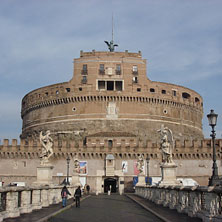
Built as a mausoleum for Emperor Publius Aelius Traianus Hadrianus, also known as Hadrian (76-138 AD) and the family tomb of the Antonine dynasty, with the Emperor Aurelian and later with Emperor Honorius this imposing building was incorporated into Rome’s city walls and was turned into a kind of fortress to defend the city. Thanks to these characteristics, it acquired the epithet castellum from that time on, which would be joined by that of sancti angeli in the early Middle Ages, following the legend of the vision of the archangel Michael sheathing his sword, signifying the end of the plague.
Its proximity to St Peter’s Square, its strategic position controlling entry to the city from the north and its compact and imposing structure all contributed to making Castel Sant'Angelo the focus of political interests, inextricably linking its fate to that of the Church, right from when Pope Urban V in 1367 demanded the keys to the castle in exchange for the return of the Curia to Rome.
From that time on, many architectural modifications were carried out on the building and new wings and features added, done on the one hand to update the building to meet its new defensive requirements with the construction of its ramparts and pentagonal walls, on the other to make it more comfortable and in keeping with the aspirations of the Curia, assuming the look of a true prince’s residence during the reign of Alessandro Farnese, or Pope Paul III (1534-1549).
The exhibition ends by examining more recent history, when the castle was used only as a jail for political prisoners, known as Forte Sant'Angelo, and finally in 1925 when it was turned into a national museum. Its appeal remains the same, as well as its ability to make an impression on the city’s collective imagination, with its Girandola event that every year takes place on the 29th June, the celebration in honour of the city’s patron saints, and covered in the fourth and last section.